

Differentiation in Behavioral Health: How to Build a Clear Signal in a Crowded Market
Behavioral health isn’t “the same everywhere.” But the market often sounds the same everywhere. When every organization uses the same language—“compassionate,” “evidence-based,” “we’re here for you”—people can’t tell the difference. And when people can’t tell the difference, they don’t compare quality. They default to convenience.
Differentiation is not a gimmick. It’s clarity. And in behavioral health, clarity becomes access—because people can’t choose what they can’t understand.
Stratica AX exists to build the angle: the clarity, proof, and positioning that makes the right clients say, “This is for me.”
What Differentiation Actually Is (And What It Isn’t)
If your differentiator is “we care,” you don’t have a differentiator. Of course you care. So does everyone else.
Differentiation isn’t louder marketing. It’s a sharper signal. The goal is not to sound impressive—it’s to be easy to understand, easy to trust, and easy to choose.
The four differentiation levers
- Specificity: who you help (and who you don’t), and what you’re best known for.
- Process clarity: what happens next, step-by-step, and what “fit” looks like.
- Proof signals: credibility and outcomes language (not promises) that build confidence.
- Experience design: the way your program feels operationally—speed, support, communication, coordination.
Why “Angle” Usually Isn’t Missing—It’s Invisible
Your angle is often already inside your team. The most differentiated organizations already have a unique clinical philosophy, a strong program model, and a specific population they serve best.
But their online presence doesn’t signal it. The result is predictable: strong care, weak clarity. Great outcomes, generic messaging.
Stratica AX extracts what’s already true, structures it into a clear story, and builds the system to keep it consistent.
Differentiation Starts With Language That Reflects Reality
Most websites flatten everything into “services.” But mental health decisions aren’t just service decisions—they’re level-of-care and fit decisions.
When you translate clinical depth into plain-language clarity without losing integrity, the right people self-select faster, and the wrong-fit inquiries drop.
Plain-language clarity that differentiates
- Clear criteria: “This program is for X… not for Y.”
- Simple pathway: “Here’s how to start in 3 steps.”
- Realistic outcomes language: what progress looks like and how you measure it.
- Operational expectations: schedule, timeframes, what a week looks like.
Your Differentiator Isn’t Your Modality—It’s Your Experience Design
CBT, DBT, EMDR, IOP—many providers offer similar modalities. What clients remember is the experience: onboarding and first-call confidence, communication rhythms, coordination with families and referrers, and how supported they felt between sessions.
Experience design becomes differentiation when it’s made visible. A well-designed experience reduces friction, lowers anxiety, increases show rates, and improves retention.
Experience signals to make visible
- Speed-to-lead and clear next steps (what happens after a call/form).
- A predictable intake flow (assessment → verification → scheduling → start).
- Support expectations (who communicates, how often, what to do between visits).
- Coordination norms (families, referral partners, care teams).
Referrers Don’t Refer to “Great Care.” They Refer to Clear Programs
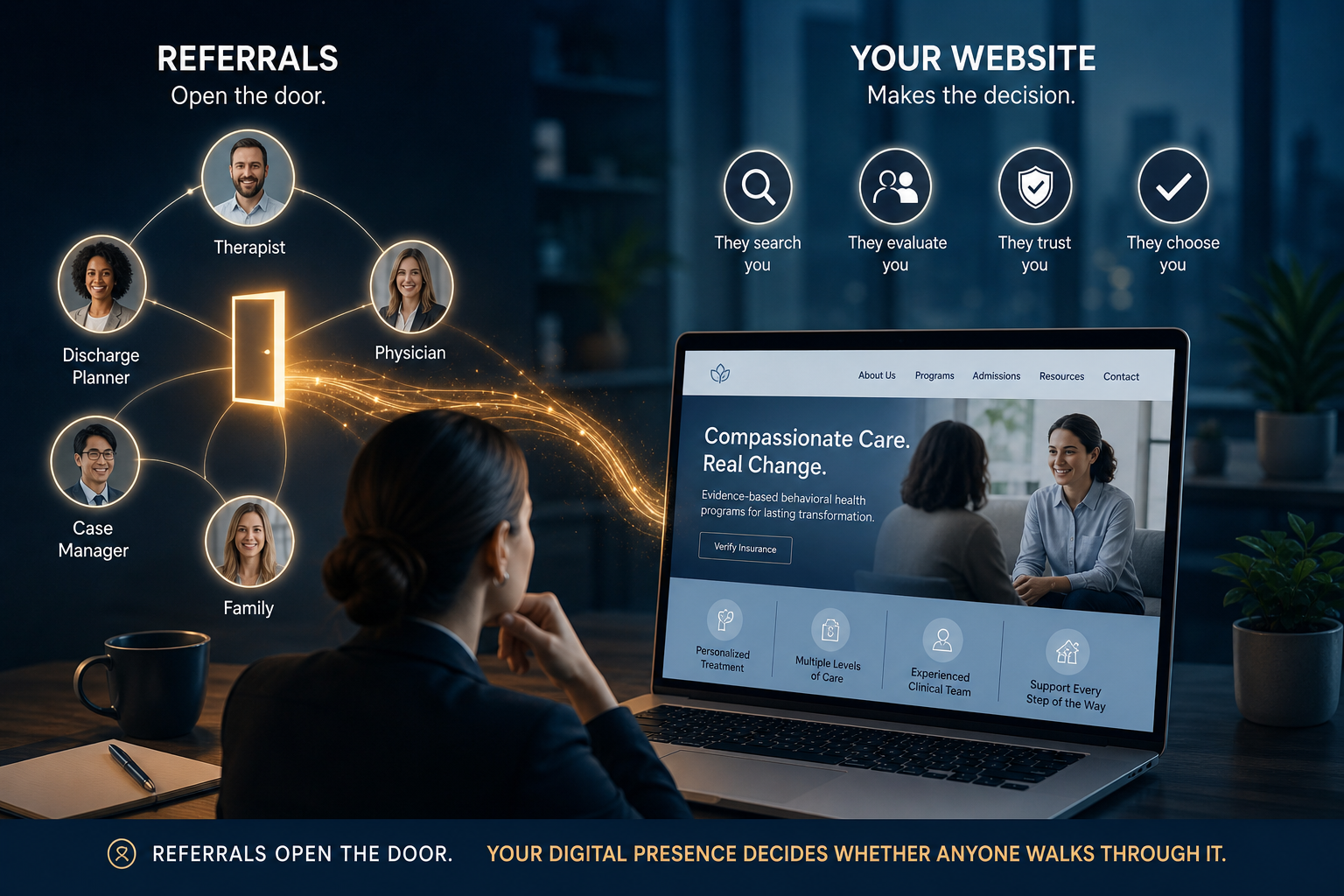
Community partners and referral sources need a sentence they can repeat confidently: “Send us X, for Y, when Z is true.” If they can’t explain you quickly, they won’t.
Differentiation is what makes your program easy to remember and easy to recommend.
The referral sentence template
“Send us [WHO], for [WHAT], when [CRITERIA].”
This single line becomes the backbone of referral one-pagers, outreach scripts, website copy, and admissions language.
Commodity Markets Reward Trust Signals, Not Clever Slogans
In mental health, people don’t buy hype. They buy confidence.
Confidence comes from transparent expectations, outcomes language (not promises), clinician credibility, and process clarity (what happens next, who it’s for, how it works).
Differentiation is the visible expression of those trust signals—delivered consistently.
In a Commodity Market, Consistency Becomes the Differentiator
Most organizations have bursts of marketing… then silence. Clients don’t interpret silence as “busy.” They interpret it as uncertainty.
Consistency communicates stability, competence, and operational readiness—without you ever saying those words.
Stratica AX builds systems so your visibility and authority don’t depend on someone “finding time,” and your brand doesn’t reset every month.
The Angle Isn’t a Gimmick—It’s Alignment
When your messaging, services, client journey, and internal operations don’t match, growth feels like pushing a boulder uphill.
Our approach is simple: Assess the system. Align the story. Build the visibility engine. Big changes often come from a small tweak—when the system is finally pointed in the right direction.
A Practical Differentiation Checklist
- Can a stranger understand who you help in 10 seconds?
- Do you clearly state who you are not for?
- Is your level-of-care guidance plain-language and usable?
- Do you show the next step (and the step after that) clearly?
- Do you communicate realistic outcomes and how progress is measured?
- Do you have a referral sentence partners can repeat?
- Does your online presence reflect your actual experience design?
- Is your visibility consistent month-to-month?
Closing
Differentiation isn’t about being flashy. It’s about being clear—clear enough that clients and families can move forward, and referrers can send the right people without hesitation.
If things feel stuck, don’t push harder. Assess the system. Align it. Then adjust.
Ready to sharpen your signal? Request a Visibility Assessment.